Launch offer — valid today only

The FCC Technician Exam, One Illustrated Page at a Time With Every Topic Drawn Step by Step!

License rules, the Technician bands, repeaters, the radio horizon, Ohm's law, decibels, antennas and RF safety: in most study guides, it's all a wall of text. Here, each topic fits on one page, with a drawing and what you need to remember. Built on the 2026–2030 question pool. 84 illustrated pages.

I WANT THE ILLUSTRATED BOOK

🔒 Secure checkout · PDF by email · 30-day guarantee

One topic per pagethe drawing shows you the rule and the text backs it up
84 illustrated pages11 parts, from your license to exam practice
Up-to-date sourcesNCVEC 2026-2030 question pool and FCC 47 CFR Part 97

This Is What the Pages You Will Study Look Like

One topic per page, the drawing that shows you how it works and the boxes with what you need to know:

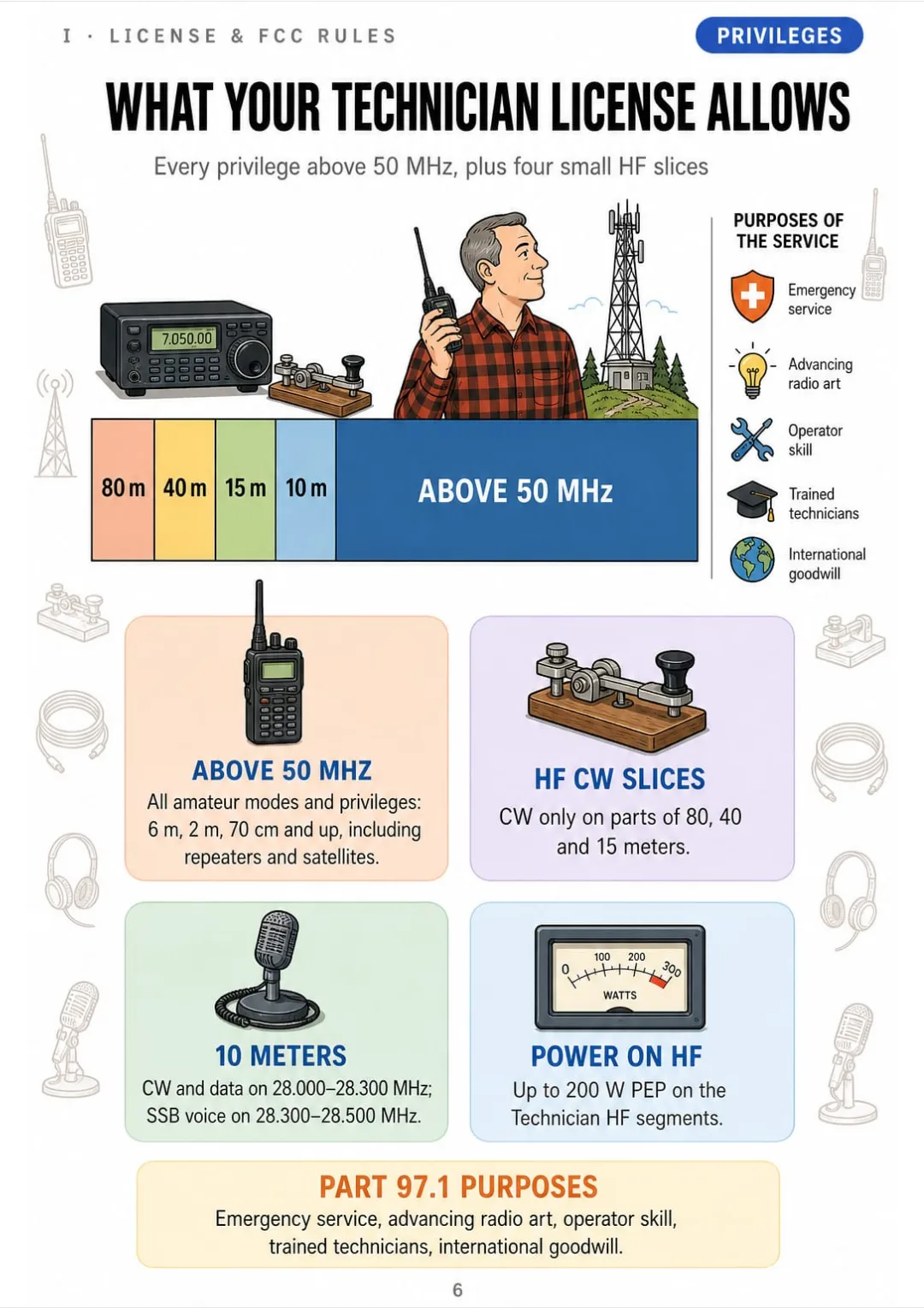
Technician privileges: all bands above 50 MHz, CW on 80/40/15 m, SSB on 10 m, 200 W PEP on HF.
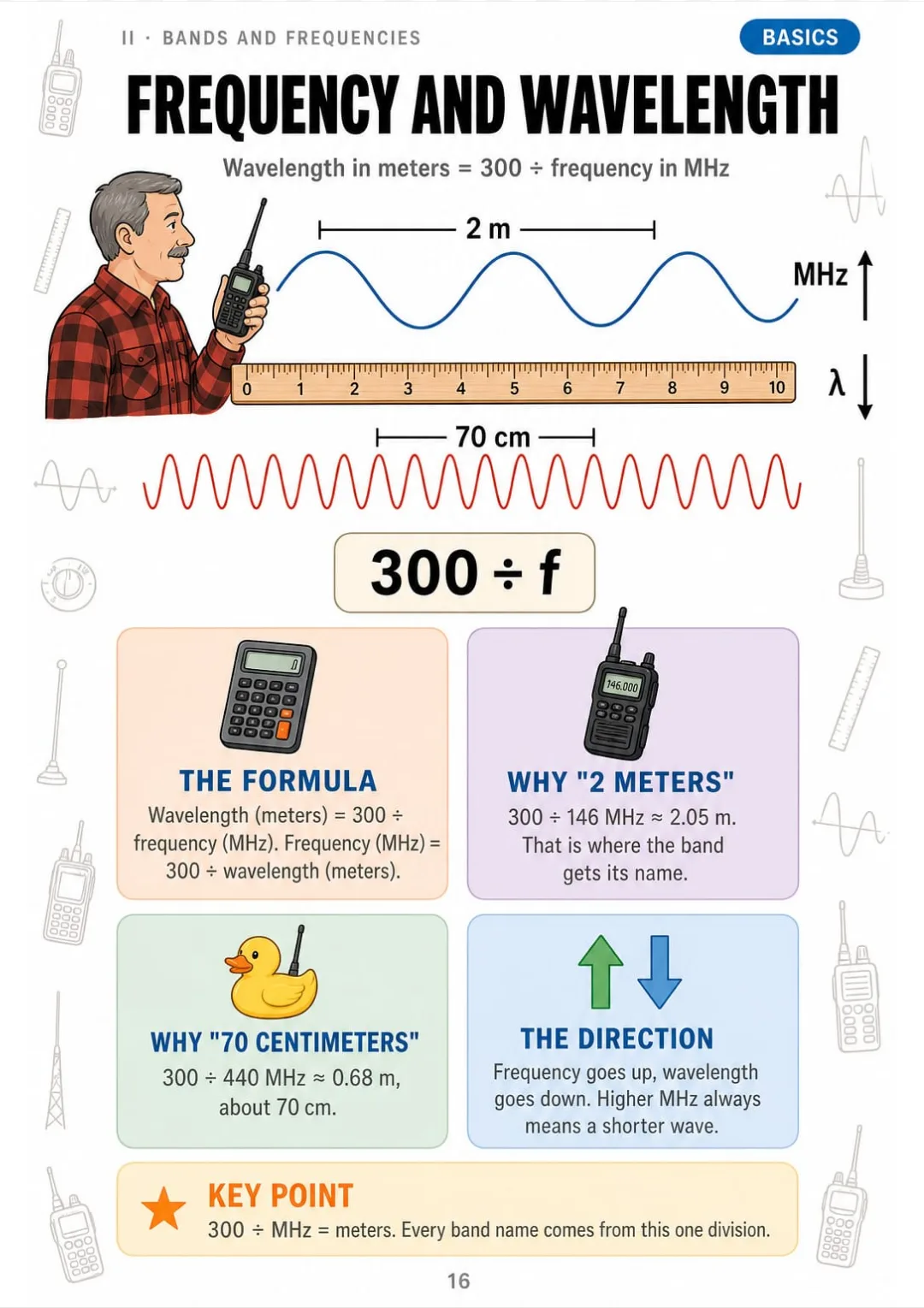
300 ÷ 146 MHz ≈ 2 m: the band name comes from one division.
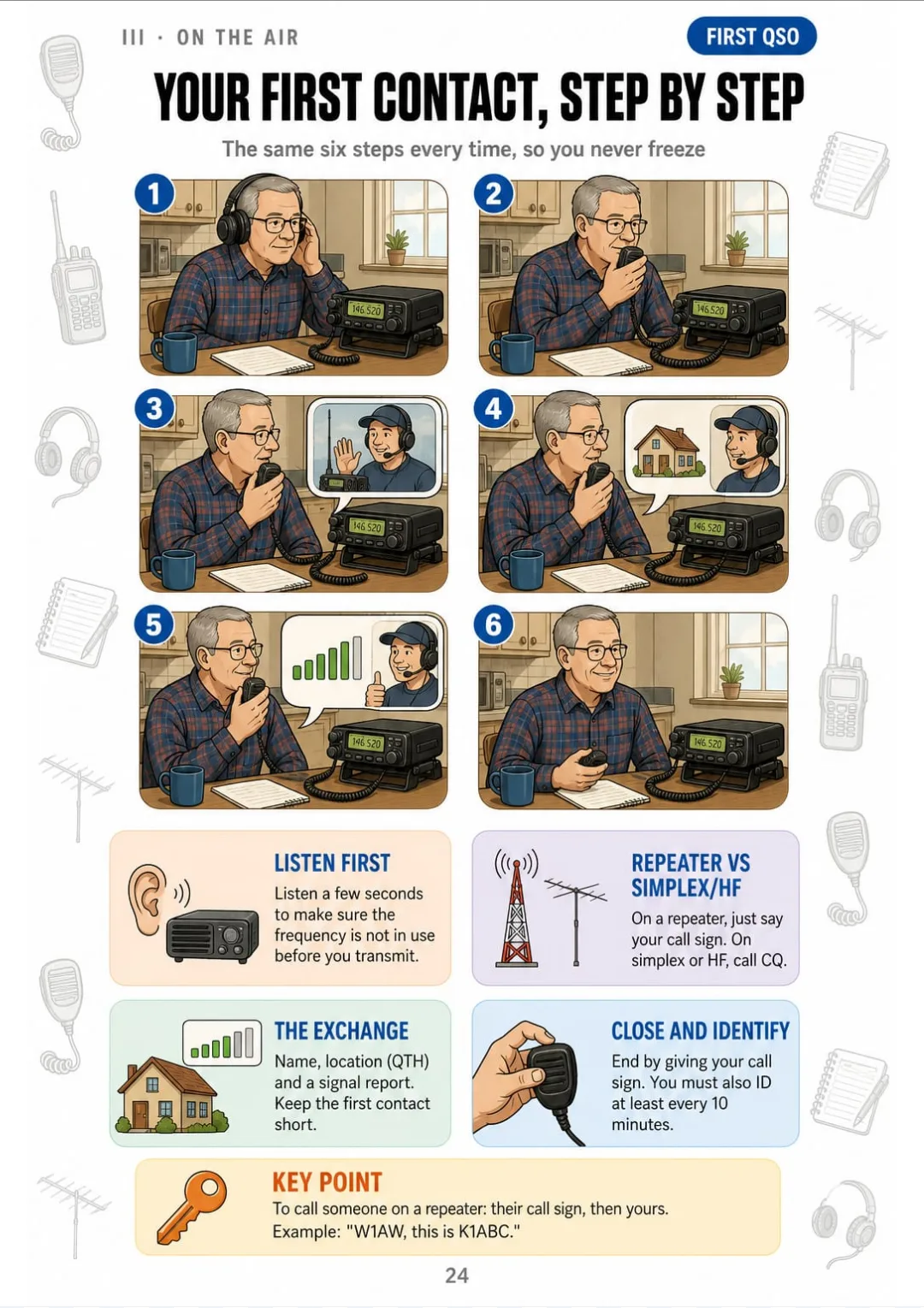
Listen, call, exchange name, QTH and report, then identify: six drawn steps.
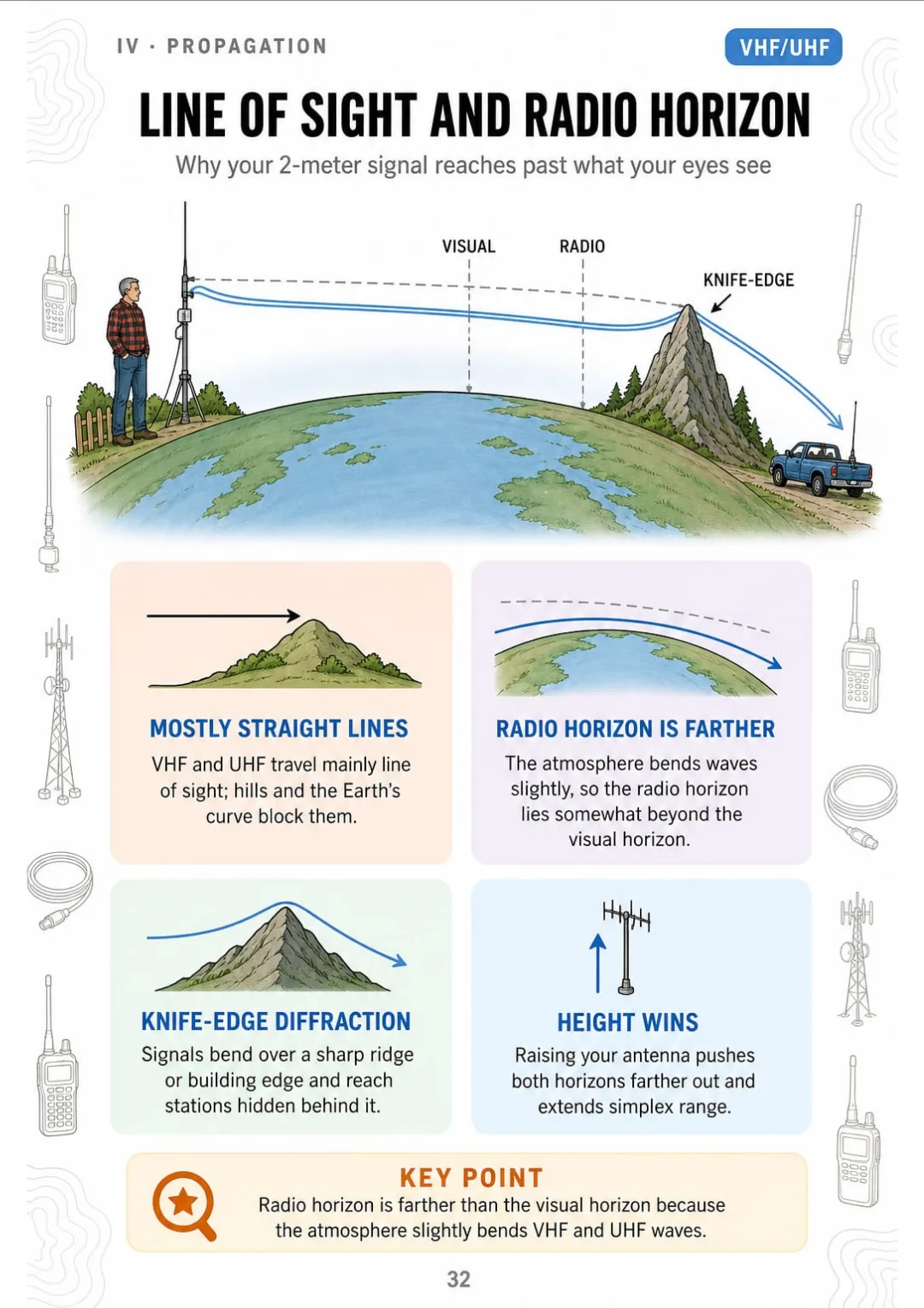
Radio horizon vs visual horizon, plus knife-edge diffraction, drawn on the curve of the Earth.
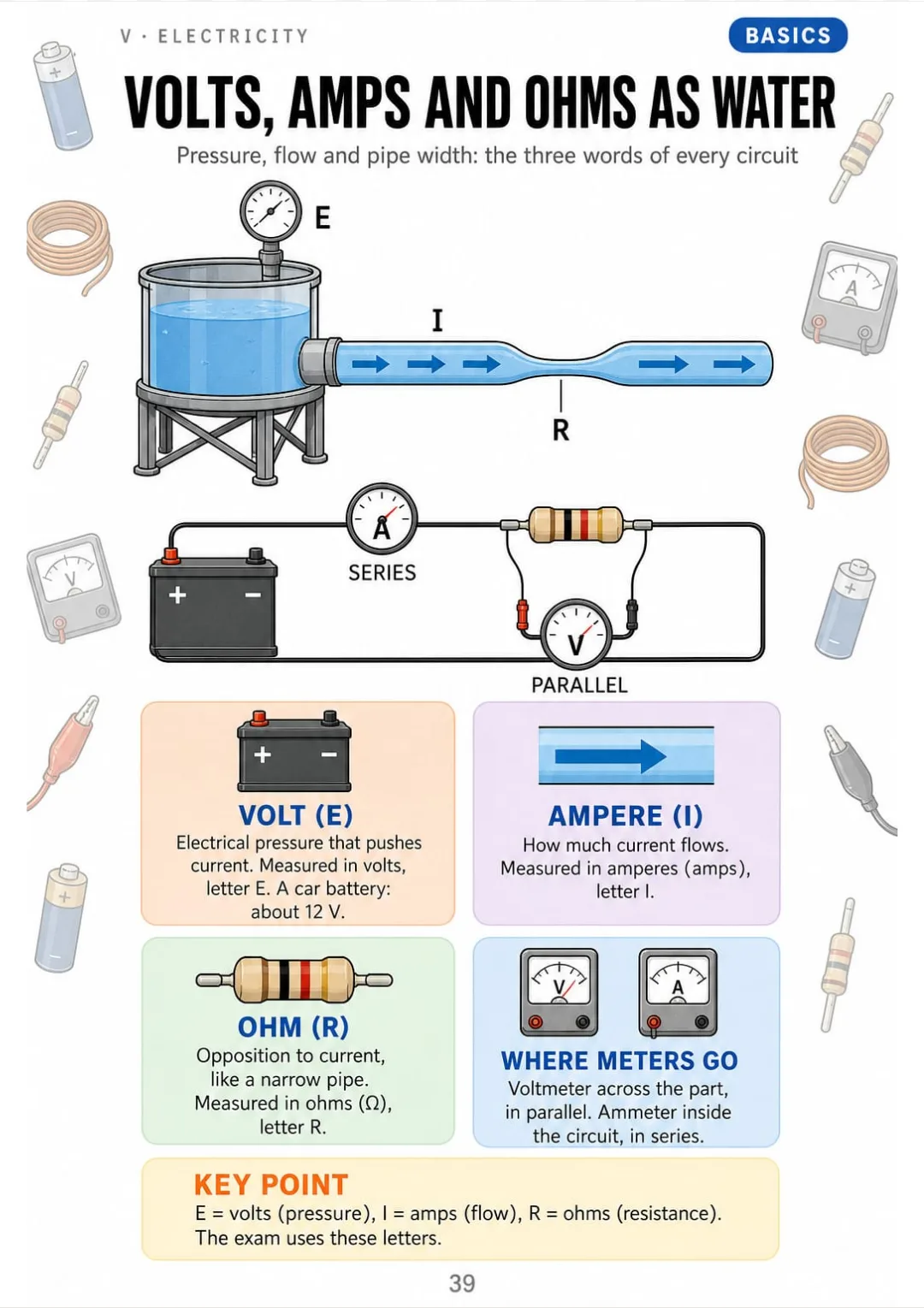
Volt (E), ampere (I) and ohm (R) drawn as pressure, flow and pipe width.
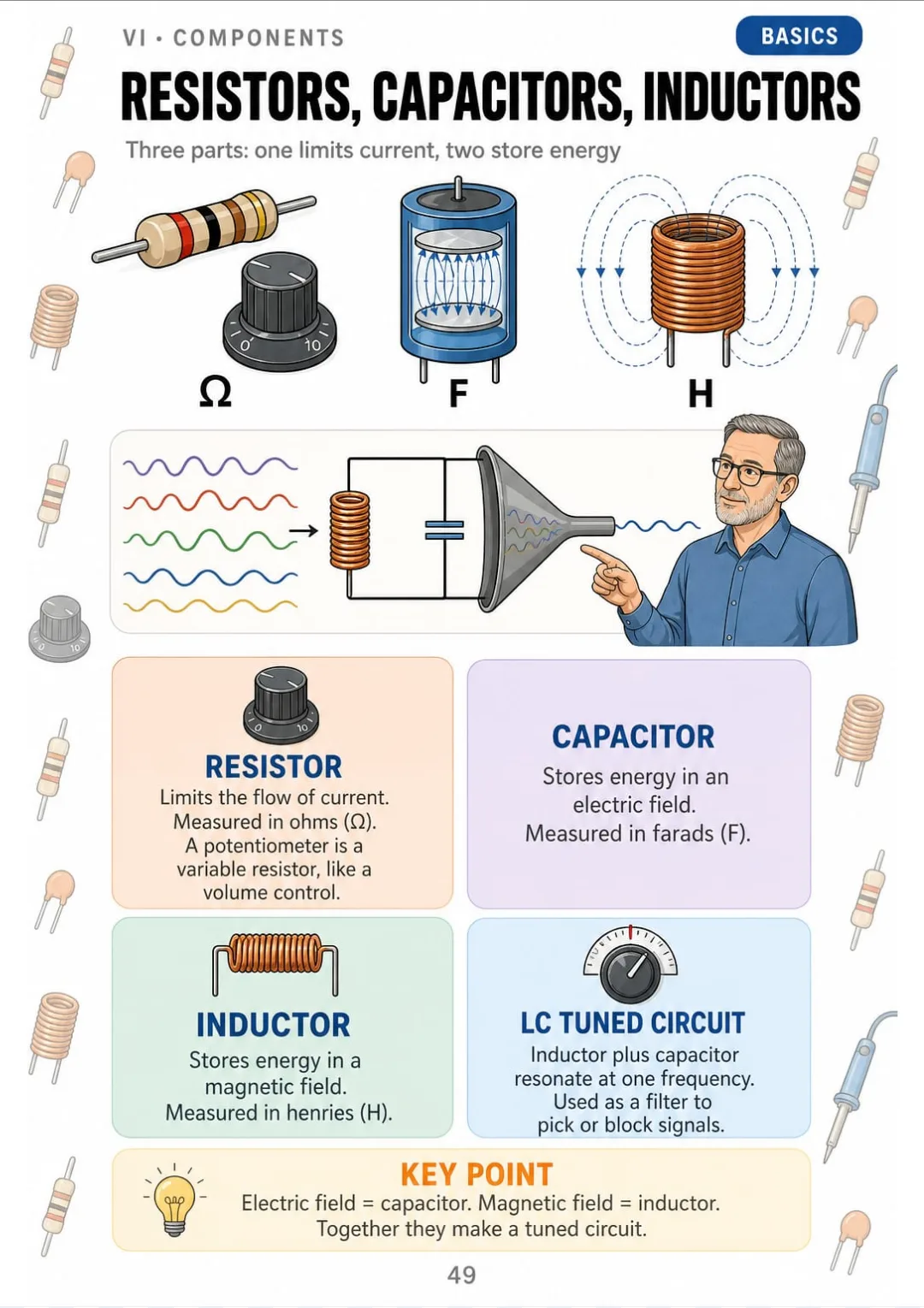
Resistor in ohms, capacitor in farads, inductor in henries: drawn side by side.
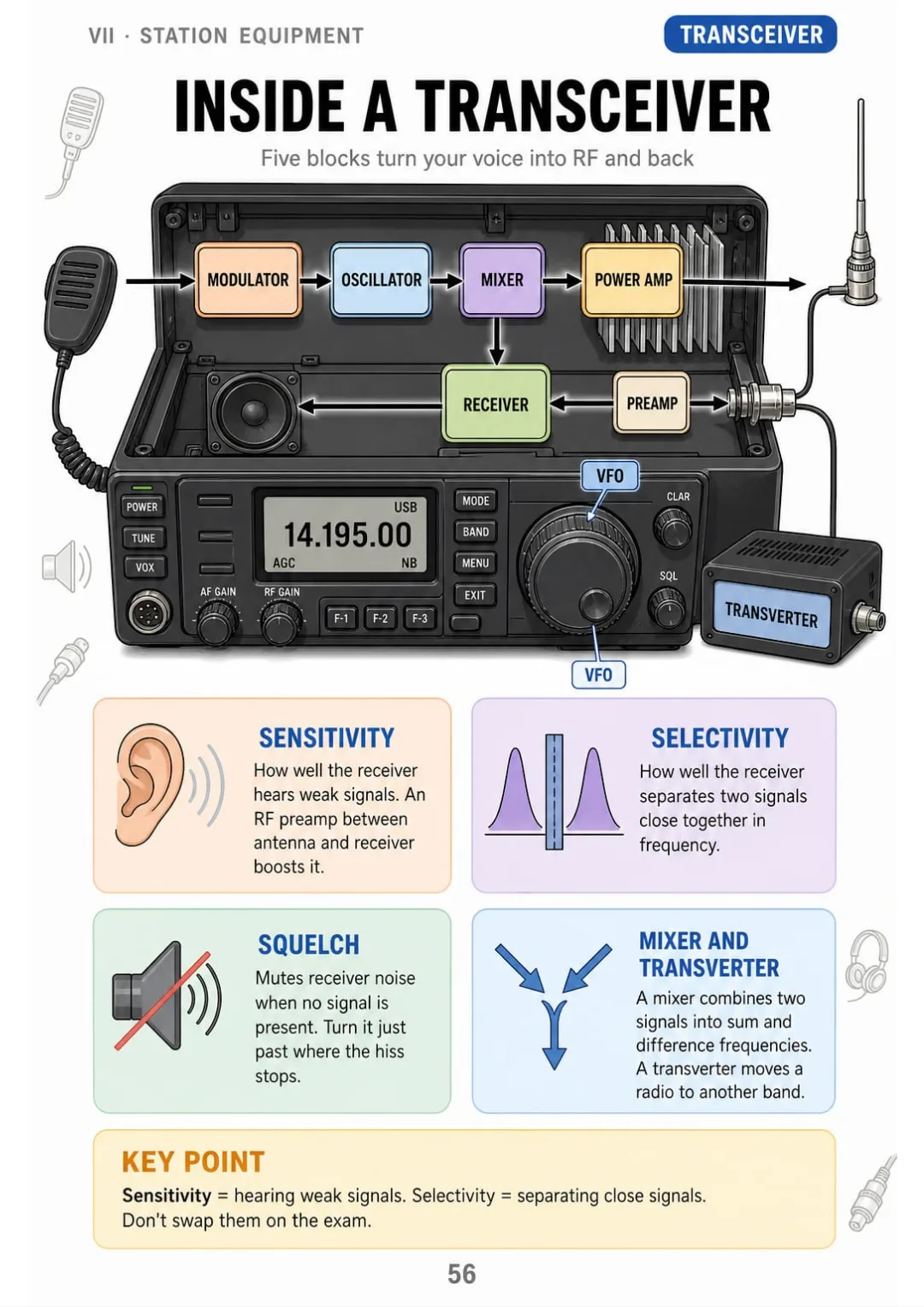
Oscillator, mixer, modulator, power amp and receiver, plus sensitivity vs. selectivity and squelch.
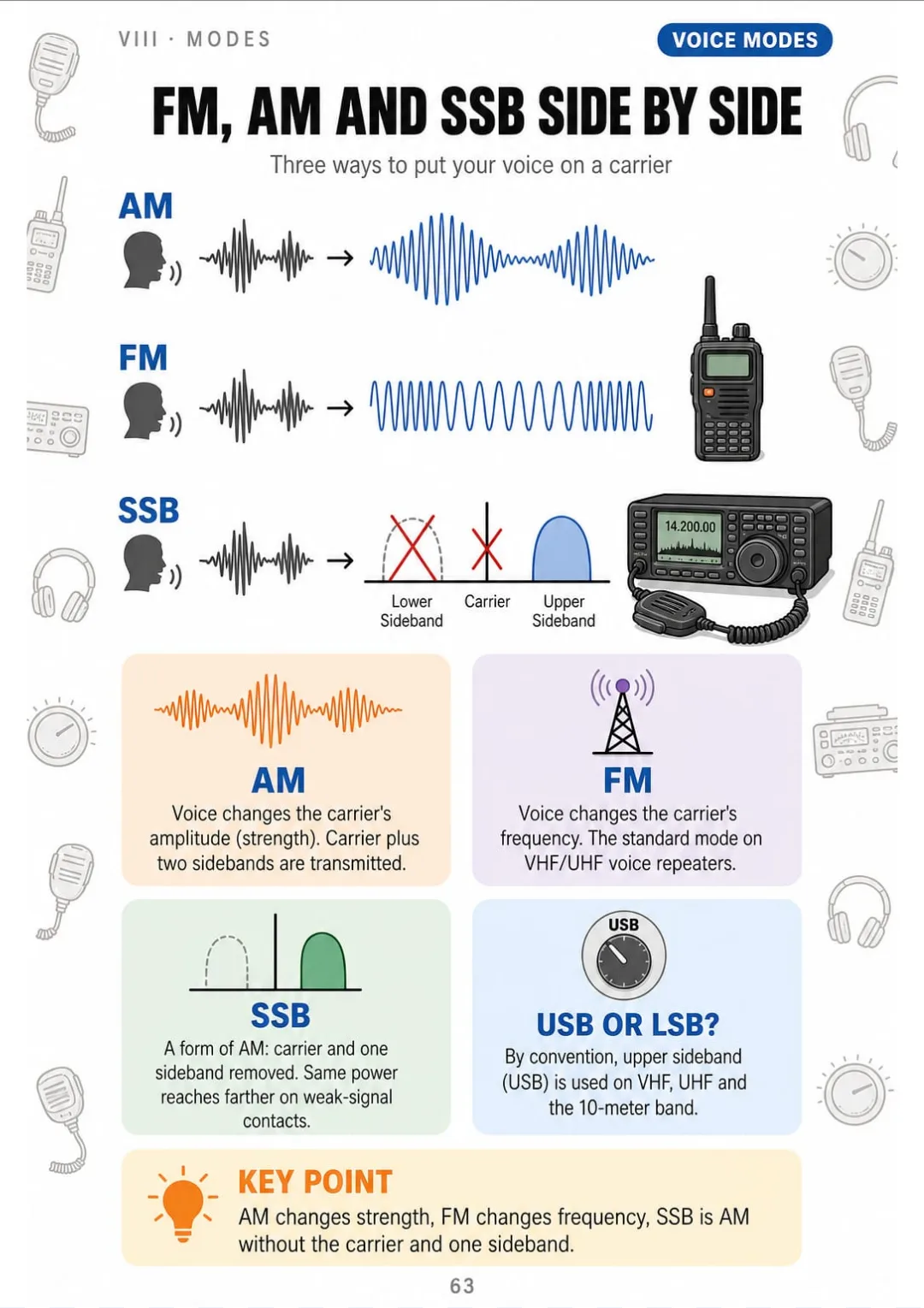
AM, FM and SSB in three drawn waves — plus why USB is used on VHF, UHF and 10 m

Swipe to see more →

These are real pages from the book. The table of contents is the full one: 11 parts and 79 topics.

It's Not That Your Memory Is Bad. It's That Nobody Put It in Order.

You've read three times how to make your first contact on a repeater. You close the book...

...and you can't remember what comes first: listen, call or give your call sign. It was just lines of text.

Listen, call, exchange name, QTH and report, then identify: six drawn steps.

Here your first contact is a drawn sequence, six steps one after another: listen first, call, trade your name, location and signal report, then identify.

And on the pages next to it, every topic gets its own: repeater offsets and tones, the phonetic alphabet, nets, band courtesy and emergency traffic.

First you understand why it's done that way. Then the order sticks on its own.

SEE THE DIFFERENCE

Stop memorizing formulas you can't picture:

THIS
  • Pages and pages of cramped text
  • Formulas without a single drawing
  • On exam day, you don't know where to start
Wavelength (λ) is defined as the distance traveled by a radio wave during one complete cycle and is inversely proportional to frequency. For electromagnetic radiation propagating in free space at approximately 300,000,000 meters per second, the relationship may be expressed as λ (meters) = 300 / f (megahertz). Consequently, any increase in frequency results in a corresponding decrease in wavelength. Amateur bands are customarily designated by approximate wavelength; thus, frequencies between 144 and 148 MHz are referred to as the 2-meter band, while 420 to 450 MHz constitutes the 70-centimeter band.
FOR THIS
  • Every formula drawn
  • One topic per page, with the rules in boxes
  • You remember it because you've seen it
300 ÷ 146 MHz ≈ 2 m: the band name comes from one division.
CONTENTS

Take a Look at the 11 Parts and 79 Topics

Your license and the FCC rules, bands and frequencies, operating on the air, how radio waves travel, electricity, components, station equipment, modes, antennas, safety and exam practice: 84 pages, all illustrated

IYour License and the FCC Rules · pp. 6-15
  1. What a Technician license lets you do
  2. License term, renewal and grace period
  3. Call signs and vanity calls
  4. Who you may talk to and what you may not transmit
  5. Identifying your station every 10 minutes
  6. Control operators and station control
  7. Third-party traffic and international contacts
  8. Interference and the FCC
  9. RACES and emergency communications rules
  10. Part I review
IIBands and Frequencies · pp. 16-23
  1. Frequency and wavelength in one drawing
  2. The Technician bands on one chart
  3. 2 meters and 70 centimeters
  4. 6 and 10 meters
  5. Band edges: staying inside
  6. Band plans and calling frequencies
  7. Mode sub-bands
  8. Part II review
IIIOperating on the Air · pp. 24-31
  1. Your first contact, step by step
  2. Repeaters: offset, tones and duplex
  3. Simplex or repeater?
  4. The phonetic alphabet and Q-signals
  5. Nets and net control
  6. Emergency and distress traffic
  7. Listen first: band courtesy
  8. Part III review
IVHow Radio Waves Travel · pp. 32-38
  1. Line of sight and the radio horizon
  2. Reflection, multipath and picket-fencing
  3. The ionosphere, layer by layer
  4. Sporadic E and tropospheric ducting
  5. Polarization
  6. Meteor scatter and aurora
  7. Part IV review
VElectricity Made Simple · pp. 39-48
  1. Voltage, current and resistance as water
  2. Ohm's law triangle
  3. Power in watts
  4. Series and parallel circuits
  5. Metric prefixes without the headache
  6. Decibels on one ruler
  7. AC, frequency and wavelength math
  8. Conductors and insulators
  9. Using a multimeter
  10. Part V review
VIComponents and Circuits · pp. 49-55
  1. Resistors, capacitors and inductors
  2. Diodes and transistors
  3. Reading schematic symbols
  4. Relays, switches and fuses
  5. Transformers
  6. Integrated circuits and displays
  7. Part VI review
VIIYour Station Equipment · pp. 56-62
  1. Inside a transceiver
  2. Handheld, mobile or base station
  3. Power supplies and batteries
  4. Coax and connectors
  5. SWR meter and dummy load
  6. Interference and troubleshooting
  7. Part VII review
VIIIModes: FM, SSB, Digital and Satellites · pp. 63-68
  1. FM, AM and SSB side by side
  2. CW: Morse code on the air
  3. Digital modes: FT8, DMR, packet and APRS
  4. Working satellites: uplink, downlink and Doppler
  5. Bandwidth of each mode
  6. Part VIII review
IXAntennas and Feed Lines · pp. 69-73
  1. The half-wave dipole
  2. The quarter-wave vertical
  3. Yagis, gain and direction
  4. Feed line loss
  5. Part IX review
XSafety · pp. 74-77
  1. Electrical safety and grounding
  2. RF exposure in plain English
  3. Towers and antennas safely
  4. Part X review
XIExam Practice · pp. 78-84
  1. How the Technician exam works
  2. Practice questions 1-5
  3. Practice questions 6-10
  4. Practice questions 11-15
  5. Practice questions 16-20
  6. Practice questions 21-25
  7. Practice questions 26-30

What If Every Topic Fit on a Single Page?

Picture this:

Instead of rereading half a page about the radio horizon without being able to see it...

...you open the page and find the curve of the Earth, your antenna on a hilltop and the line where the signal stops, all in one drawing.

Volt (E), ampere (I) and ohm (R) drawn as pressure, flow and pipe width.

And Ohm's law, the Technician bands, decibels, repeater offsets and RF safety turn into drawings and charts you can read at a glance.

You stop repeating and start understanding.

That's exactly what Ham Radio Technician Made Visual does. 11 parts and 84 illustrated pages, one topic per page, and at the end 30 original practice questions with answers. What you see in order is easier to remember.

Because what your brain sees organized, it remembers.

Here Is What You Get with Ham Radio Technician Made Visual:

Ipp. 6-15

Your License and the FCC Rules

What a Technician license lets you do, license term and renewal, call signs, what you may and may not transmit, identifying every 10 minutes, control operators, third-party traffic, interference and RACES.

IIpp. 16-23

Bands and Frequencies

Frequency and wavelength in one drawing, every Technician band on one chart, 2 meters and 70 centimeters, 6 and 10 meters, band edges, band plans and mode sub-bands.

IIIpp. 24-31

Operating on the Air

Your first contact step by step, repeaters with offset, tones and duplex, simplex or repeater, the phonetic alphabet and Q-signals, nets, emergency traffic and band courtesy.

IVpp. 32-38

How Radio Waves Travel

Line of sight and the radio horizon, reflection and multipath, the ionosphere layer by layer, sporadic E and ducting, polarization, meteor scatter and aurora.

Vpp. 39-48

Electricity Made Simple

Voltage, current and resistance as water, the Ohm's law triangle, power in watts, series and parallel, metric prefixes, decibels on one ruler, AC math and the multimeter: the exam math worked out on a drawing, not memorized.

VIpp. 49-55

Components and Circuits

Resistors, capacitors and inductors, diodes and transistors, schematic symbols, relays, switches and fuses, transformers, integrated circuits and displays.

VIIpp. 56-62

Your Station Equipment

Inside a transceiver, handheld, mobile or base, power supplies and batteries, coax and connectors, the SWR meter and dummy load, and troubleshooting interference.

VIIIpp. 63-68

Modes: FM, SSB, Digital and Satellites

FM, AM and SSB side by side, CW, digital modes like FT8, DMR, packet and APRS, working satellites with uplink, downlink and Doppler, and the bandwidth of each mode.

IXpp. 69-73

Antennas and Feed Lines

The half-wave dipole, the quarter-wave vertical, Yagis with gain and direction, and feed line loss.

Xpp. 74-77

Safety

Electrical safety and grounding, RF exposure in plain English, and working safely with towers and antennas.

XIpp. 78-84

Exam Practice

How the Technician exam works, then 30 original practice questions in groups of five, with answers.

At the end of the book: 30 original practice questions with answers and a review page at the end of every part.


And That Is Not All: 2 More Books, Free

Exam Day and Call Sign Checklist

BONUS 1: «Exam Day and Call Sign Checklist»

Value on its own: US$ 17.90

Everything about exam day: getting your FRN in the FCC CORES system, finding a VE session near you or online, what to bring, how the session works, paying the FCC application fee after you pass, and how to look up your new call sign in the ULS.

Illustrated Ham Radio Glossary

BONUS 2: «Illustrated Ham Radio Glossary»

Value on its own: US$ 14.90

The radio words the exam assumes you know (QSO, CTCSS, PEP, SWR, simplex, duplex, offset, PL tone…), each one with a small drawing and a plain-English definition.

Ham Radio Technician Made Visual + 2 Free Books

  • Ham Radio Technician Made Visual: 84 illustrated pagesUS$ 63
  • BONUS 1: Exam Day and Call Sign ChecklistUS$ 17.90
  • BONUS 2: Illustrated Ham Radio GlossaryUS$ 14.90
  • High-resolution PDF to printIncluded
Total value US$ 95.80
YOUR PRICE:
US$ 27
You save US$ 68.80
YES, I WANT HAM RADIO TECHNICIAN MADE VISUAL FOR US$ 27

📄 This is a digital PDF book sent to your email: nothing is printed or shipped.

Secure purchaseEncrypted payment30-day guarantee

PDF by email: Ham Radio Technician Made Visual reaches your inbox as a PDF, and the two free books come by email too. One-time payment, no installments or hidden costs.

Is This Book for You?

You're studying for your first license

You're studying for your first license

Rules, bands, electricity and antennas, one topic per page, in the same order as the official syllabus. No technical background needed: every formula starts with a drawing.

Your exam session is coming up

Your exam session is coming up

A visual review of the whole Technician syllabus, a review page at the end of each part and 30 original practice questions with answers.

You already own a handheld

You already own a handheld

Repeater offsets and tones, your first contact step by step and why your signal reaches farther from higher ground, ready to keep next to your radio.

To Sum Up: Here Is What You Get

US$ 95.80US$ 27
YES, I WANT HAM RADIO TECHNICIAN MADE VISUAL FOR US$ 27

📄 This is a digital PDF book sent to your email: nothing is printed or shipped.

30DAYS
GUARANTEE

30-Day Guarantee

30-day guarantee: tell us what didn't work and we'll refund 100%.

You have 30 days to try Ham Radio Technician Made Visual and the two bonus books. Tell us what didn't work for you, whether it's a file that won't open, content that isn't what this page describes or anything else, and we'll refund 100% of what you paid. One-time payment, no subscriptions, no surprises.

Frequently Asked Questions

How do I get the material?

After your purchase, you'll get an email with Ham Radio Technician Made Visual as a high-resolution PDF you can read on your phone or print. The two bonus books, "Exam Day and Call Sign Checklist" and "Illustrated Ham Radio Glossary," also come by email.

Is it a monthly payment or a one-time payment?

A one-time payment of $27. No installments, no subscription. Any extra you see at checkout or after is optional and is only added if you choose it.

Who is it for?

For anyone preparing for the FCC Technician class (Element 2) exam, especially if you're not a technical person: the math starts with a drawing, not a formula, and it's division and multiplication you can do on a basic calculator. It also works alongside the free practice apps: the apps quiz you, the book shows you why. Check the table of contents above to see every topic.

What sources is it based on?

The 2026-2030 Technician Class (Element 2) question pool and syllabus from the NCVEC Question Pool Committee, in effect from July 1, 2026 to June 30, 2030, and the FCC amateur radio rules in 47 CFR Part 97. The book follows the order of the official syllabus.

Is this official FCC material?

No. It's independent study material. It isn't published, approved or endorsed by the FCC, the NCVEC, the ARRL or any Volunteer Examiner Coordinator. The book doesn't give you a license or a certificate: you earn your license by passing the Element 2 exam (35 questions, 26 correct to pass) at a Volunteer Examiner session, and then the FCC issues your call sign.

Does it replace a licensing class or the official rules?

No. It's a visual tool for studying and reviewing. It doesn't replace a licensing class, a mentor or the official FCC rules, and the RF exposure and electrical safety pages cover exam content, not engineering or medical advice.

Are the practice questions the ones on the exam?

No. The 30 questions are written for this book, in the style of the exam, so you can practice. They aren't taken from the official question pool and they aren't the questions you'll see in your exam session.

Can I print it?

Yes. It's a PDF you can print at home or at a print shop, the whole book or just the pages you want next to your radio.

What if I don't like it?

You have 30 days. Tell us what didn't work and we'll refund 100% of what you paid.

One Last Thing Before You Decide...

You don't have to reread the same page hoping it sticks this time.

You don't have to memorize formulas you can't picture.

And you definitely don't have to walk into your exam session not knowing where to start.

There's a simpler way. And it's one click away. Now it's your turn.

One-time payment: US$ 27 · Guarantee: 30 days · PDF by email

YES, I WANT HAM RADIO TECHNICIAN MADE VISUAL FOR US$ 27

📄 This is a digital PDF book sent to your email: nothing is printed or shipped.